Chapter V, Places
Famous temples in Thailand, where to start your visit
What makes a wat famous, the best known temples in Bangkok, Chiang Mai and beyond, and how to plan a respectful visit.
What makes a wat famous
A wat becomes famous because of its age, its architecture, a revered image or relic, or its role as a place of pilgrimage. Thailand has tens of thousands of temples, so a short list can never be complete. What is the most famous Buddhist temple in Thailand? There is no official ranking, but Wat Phra Kaew, home of the Emerald Buddha inside the Grand Palace, and Wat Pho with its reclining Buddha are among the best known for visitors.
Age
Age gives a temple weight, and Thailand's oldest sites are protected as historical parks. The historic town of Sukhothai and the historic city of Ayutthaya were both inscribed on the UNESCO World Heritage List in 1991. Their ruined and restored temples show the architecture of the early Thai kingdoms. The question of the oldest temples in Thailand is hard to settle, because many temples are rebuilt on older foundations and records are incomplete, so treat any single “oldest” claim with caution.
Architecture
Thai temple architecture combines a few recurring buildings: the ordination hall (ubosot), the assembly hall (viharn), the reliquary tower (chedi or prang), and the monks' living quarters. The ubosot stands inside a boundary marked by eight boundary stones, called sema. Roofs are often tiered, with decorative gables and finials, while northern temples have their own regional styles. The Khmer-influenced tower, the prang, is the sign of Wat Arun. You can see how the parts fit together in the overview of the main areas of a wat.
Pilgrimage
Some temples are pilgrimage sites because they hold a revered image or a relic of the Buddha, and Thai Buddhists travel there to make merit and to pray. Visitors may find these places busy on holy days and during festivals. Plan around the crowds, and remember that you are a guest at a place where people are praying.
Bangkok
Bangkok's best known temples are Wat Pho, Wat Arun and Wat Phra Kaew, and they can be reached in one day from the Chao Phraya river. Together they answer the search for a Thai temple in Bangkok better than any other group.
- Wat Pho is known for its large reclining Buddha, which is reported to be about 46 metres long and 15 metres high. The temple was rebuilt from 1788 under King Rama I. Sarongs are available at the entrance for visitors who are not dressed properly.
- Wat Arun, the Temple of Dawn, stands on the western bank of the river. A temple stood on the site before Bangkok was founded, and the large Khmer-style central tower was added in the early nineteenth century.
- Wat Phra Kaew lies inside the Grand Palace, the residence of the kings of Siam from 1782. It enshrines the Emerald Buddha, which was moved there from Wat Arun in 1785. Dress rules at the Grand Palace are applied strictly.
Make sure to review dress code before you go: all three enforce the covered shoulders and knees rule, and Wat Phra Kaew is stricter than its neighbours.
Chiang Mai
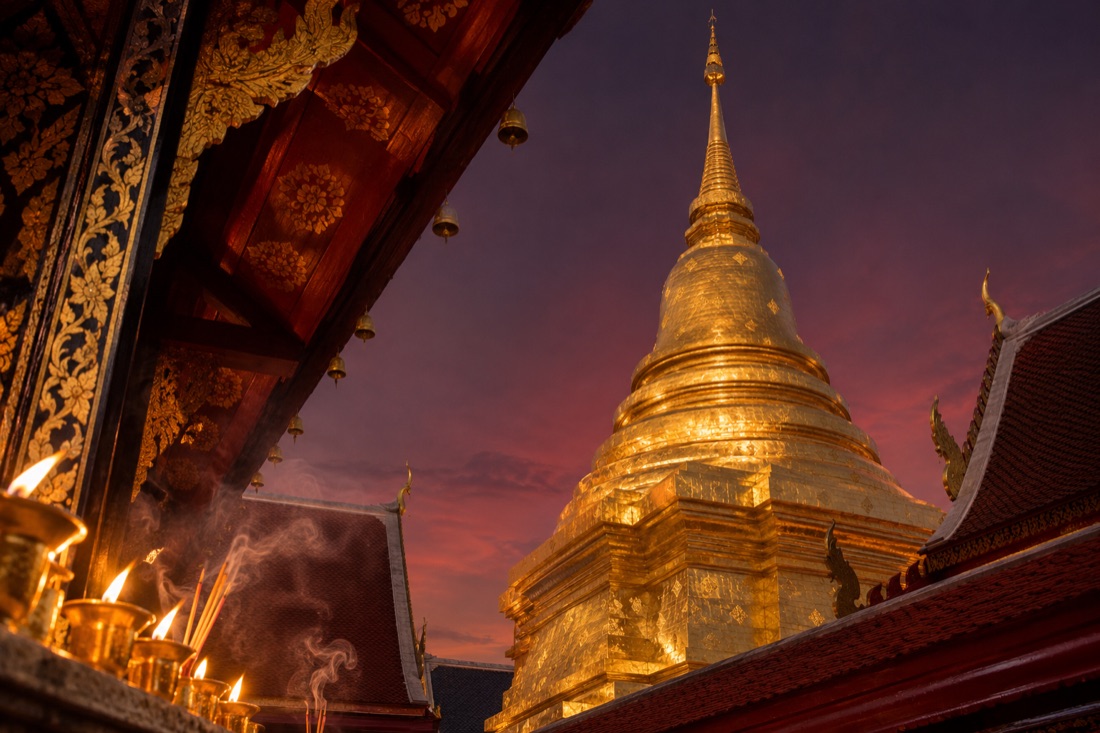
Chiang Mai is the centre of northern Thai temple culture, and the best known temple near it is Wat Phra That Doi Suthep, which sits on a mountain above the city and is traditionally dated to about 1383. A climb of many steps leads up to a gilded chedi that shines in the sun. The founding story involves King Ku Na of the Lanna kingdom and a sacred white elephant, but historians treat the details as legend.
The old walled city also contains many temples in the Lanna style, with sweeping roofs and carved wooden gables. If you look for a Chiang Mai temple to visit, plan to visit in the morning or late afternoon, when it is cooler and the light is soft. Dress the same as in Bangkok, and take shoes that are easy to remove, since you will leave them often.
Other regions
Outside Bangkok and Chiang Mai, several regions have temples that are worth a longer trip.
- Sukhothai and Ayutthaya are historical parks with the ruins of early capitals. Ayutthaya was founded in 1350 and its listing includes Wat Mahathat, Wat Phra Ram and Wat Ratchaburana. These sites are best explored by bicycle or on foot.
- Wat Rong Khun, the White Temple near Chiang Rai, is a contemporary work by the artist Chalermchai Kositpipat. He began rebuilding the old temple in 1997 and the project, which he has funded himself, is still unfolding. It is an artistic statement about Buddhism, and it remains an active place of worship.
- Forest monasteries such as Wat Pa Tam Wua in the north-west offer a quieter experience for people who want to see how monks live and practise. See meditation at a Thai wat.
How to plan a temple visit
To plan a temple visit, pick no more than two or three temples per day, go early before the heat and the crowds, dress properly, and check the current opening hours and fees on the temple's own signage or official source. Opening hours, ticket prices and rules change, and published sources disagree on prices, so this guide does not list them.
Opening hours
Many large temples open in the morning and close in the late afternoon, and some close certain halls for ceremonies. Local temples may be open all day. Because hours change, confirm them on the day, and arrive early for the quietest experience and the softest light. On Buddhist holy days some temples are crowded with worshippers, and visitors should stay out of the way.
Dress and etiquette recap
Wear sleeves and below-the-knee bottoms, carry slip-on shoes and a scarf, keep your voice low, and never point your feet at an image or a monk. The longer version is in temple etiquette and in the dress guide. If you like what you see and want to understand the people who live there, monks and alms is the next page to read.
Finally, remember that a temple is not a stage set. Even at the most famous sites, there are monks at work, people praying and caretakers sweeping. A visitor who moves slowly, speaks quietly and follows the signs will see more than one who rushes.