Chapter I, Conduct
Thai temple etiquette, the dos and don'ts for visitors
Shoes, posture, monks, photos and prayer: what to do and what to avoid inside a Thai wat, in the order you will meet it.
What is Thai temple etiquette
Thai temple etiquette is the set of habits that show respect for a working Buddhist monastery: dress modestly, take off your shoes, keep your voice and your feet low, and treat monks and Buddha images with care. A wat is not a museum. It is a place where monks live, where families pray, and where many Thai people come to make merit, so the rules are about sharing a space with a living religion.
Visitors are welcome at most temples, and the answer to can I just show up to a Buddhist temple is usually yes. You do not need an appointment, a guide or any religious belief. You do need to arrive dressed properly and to behave quietly. Famous sites in Bangkok and Chiang Mai charge an entry fee for foreigners, while many village temples are free to enter, so keep a small amount of cash for donations or tickets.
Why the rules exist
The rules exist because the buildings are sacred and the monks follow a strict code of conduct. The ordination hall, the assembly hall and the Buddha images inside them are treated as objects of reverence. In Thai custom the head is the highest and most respected part of the body and the feet are the lowest, so many of the rules simply keep your body in a respectful order: head up and calm, feet tucked away and never pointed at a person or an image.
If you have not yet planned your clothes, read what to wear to a Thai temple first, because dress is the rule that visitors are most often stopped for at the gate.
Rules at the entrance
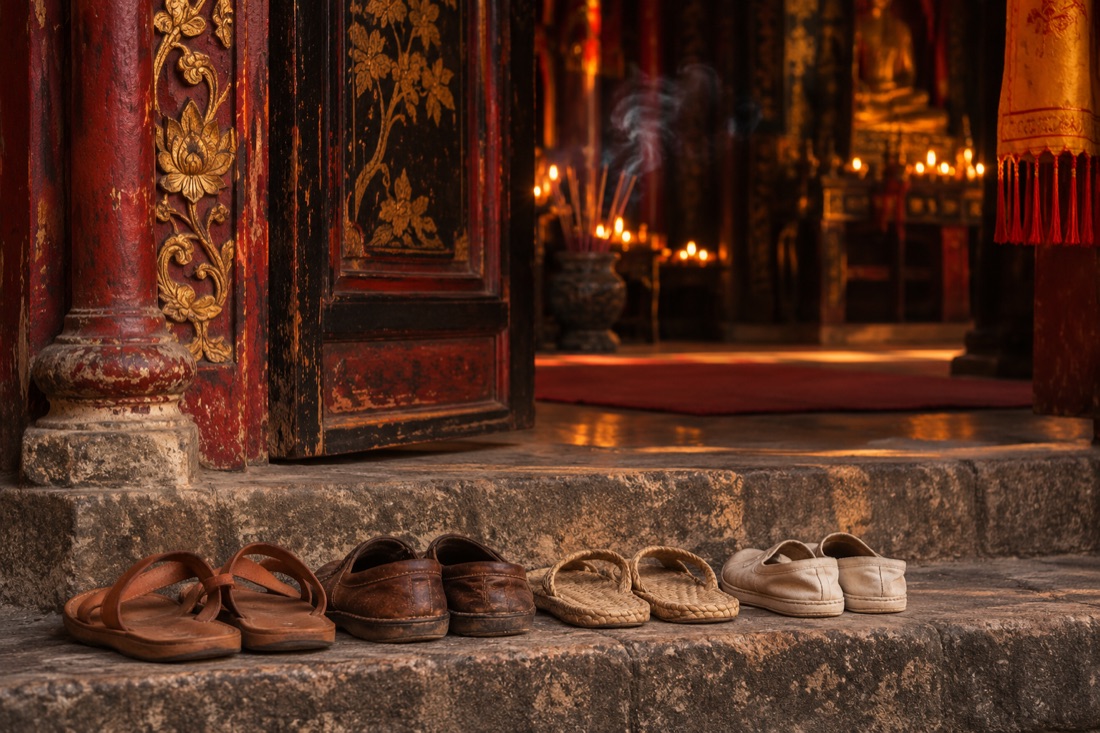
At the entrance, check that your shoulders and knees are covered, remove your shoes where you see shoes left outside, and step over, not on, any raised threshold. Most temples have a rack or a mat for footwear at the door of each hall, and a pile of sandals is the clearest sign that you should leave yours too.
Shoes
Take your shoes off before entering any hall that houses a Buddha image, and also before entering a monk's residence or a private home. Leave them neatly at the side of the door, not in the middle of the doorway. Socks are generally accepted, and many visitors wear them because stone floors and courtyards can be hot in the sun. If a sign asks for bare feet, follow the sign. Carry a small bag so you can bring your shoes with you if you are worried about losing them.
Doorway thresholds
Many Thai halls have a raised wooden sill at the doorway. Step over it rather than standing on it. Traditional belief treats the threshold as the place where the building's protective spirit resides, and standing on it is considered discourteous. It is a small gesture that Thai visitors notice and appreciate.
Inside, walk calmly and speak quietly. Switch your phone to silent, finish your call outside, and keep food, chewing gum and cigarettes out of the halls. Smoking and drinking alcohol inside temple grounds are not accepted. Sit or stand so that nobody has to pass in front of a person who is praying.
Behaviour toward Buddha images and monks
Treat every Buddha image as an object of worship: do not touch it, climb on it, point at it or pose in a disrespectful way beside it. Treat monks with the same courtesy: give them space, let them go first, and never touch them. These two relationships carry most of the rules in this guide.
Posture and feet
Never point your feet at a Buddha image or at a monk. When you sit on the floor in front of an image, tuck your legs to one side behind you, with your feet pointing away from the image. This is called sitting in the phap phiap style in Thai, and it is the posture you will see on most worshippers. Do not sit with your legs crossed in a way that puts a sole toward the image, and do not stretch your legs out while you rest.
Do not step over anyone sitting on the floor, and do not step over food, bags or offerings. If someone is praying and you must pass, walk behind them and lower your body slightly.
Touching and photographing
Photography is allowed in many temple courtyards, but it is limited or banned in some halls, so look for signs before you raise a camera. Never use a flash on murals or near people who are praying. Do not take selfies that put your back to a Buddha image, do not pose with a hand on the image, and avoid photographing monks at close range without asking. In places where photography is permitted, take your photo, then step aside so others can pray.
Do not touch or climb on Buddha images, even small ones outside, and do not buy or carry images as fashion items or decoration in a way that places them below the waist. A Buddha image on a T-shirt or a tattoo on the leg can cause offence. If you buy an image as a souvenir, treat it respectfully and place it somewhere high and clean.
Women and monks
A woman must not touch a monk or hand him anything directly. This rule comes from the monastic code that the monks follow. Monks traditionally use a receiving cloth, or you place the item on a table or on the cloth he holds out. If you are a woman sitting near monks, leave a respectful gap. Men are also asked not to touch monks casually, and nobody should sit higher than a monk or hand him an item in a rush. For the full picture of offerings and the morning round, see giving alms to monks.
The traditional greeting is the wai: palms together in front of the chest or face and a slight bow. Visitors are not expected to wai a monk perfectly, and monks generally do not return a wai, so do not take that as rudeness.
Common mistakes
The most common mistakes are wearing shorts or sleeveless tops, forgetting to remove shoes, pointing feet at an image, touching a monk, and treating sacred objects as props. The answer to what not to do in a Buddhist temple comes down to a short list:
- Do not enter with bare shoulders, bare knees or see-through clothing.
- Do not climb on, touch or pose with Buddha images or stupas.
- Do not point your feet at an image or a monk, or stand on a threshold.
- Do not touch a monk, and women should not hand items to a monk directly.
- Do not talk loudly, take calls, or play music in the halls.
- Do not wear hats or sunglasses inside the halls, and avoid showing off tattoos of sacred symbols.
- Do not litter, and do not take stones, flowers or small objects as souvenirs.
If you are unsure, watch the people around you and copy them. Thai visitors, and temple staff, are generally patient with an honest mistake and quick to show you the right way.
How to show respect step by step
A respectful visit follows a simple order. The steps below also answer what do you do at a Thai temple and how to pray in a Thai temple for first-time visitors.
- Dress before you leave. Cover your shoulders and knees. Carry a scarf or light shirt for the gate.
- Enter calmly. Walk in quietly, switch your phone to silent and step over thresholds.
- Remove your shoes at the hall door and leave them tidily.
- Greet the image. Many Thai worshippers kneel, place palms together and bow three times, touching the floor with forehead and palms, in honour of the Buddha, the Dhamma and the Sangha. You can bow once with palms together, or simply sit quietly for a minute.
- Make an offering if you wish. Visitors often buy a set of flowers, candles and incense sticks at a stall near the entrance. Place them at the designated spot, light them if the area allows, and do not leave burning items unattended. A coin or banknote in a donation box, or pressing a small square of gold leaf onto a statue where that custom is accepted, is a way to take part. Ask the temple if you are not sure what is allowed.
- Leave without turning your back on the image. Many worshippers back away a few steps before turning. It is a courtesy, not a requirement for visitors.
- Offer thanks. A short wai at the exit is enough.
Once you have the basics, the next question is who lives in the temple. Monks, alms and offerings covers daily life, and famous temples in Thailand helps you decide where to go first.